




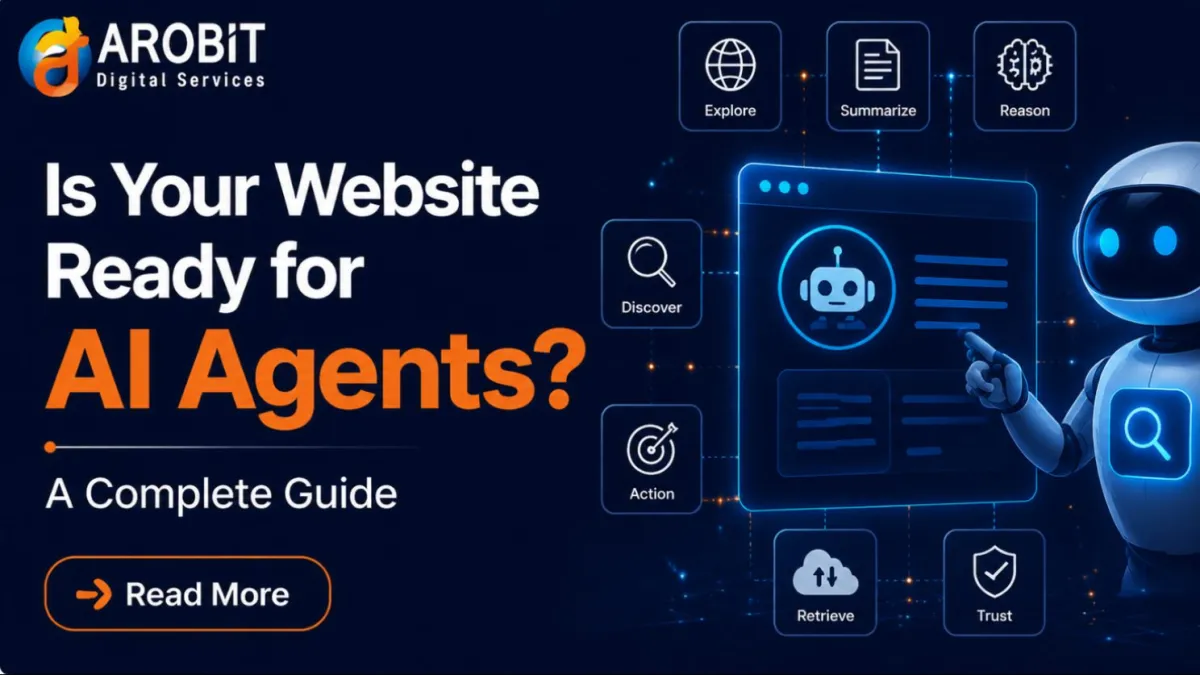
Websites are no longer discovered only through search engines and human clicks. ChatGPT, Gemini, Claude, and Perplexity now browse the web on a user's behalf, and browser-based automated agents are starting to complete tasks like comparing products or filling out forms without a person clicking through each page. This shift is often described as Agentic Browsing, and it's changing what it means for a website to be "discoverable" in the first place.
If your site was built purely for human visitors and traditional crawlers, it may not be ready for this next layer of traffic. This guide breaks down what Agentic Browsing means, how these systems actually read websites, and what businesses can do to prepare.
AI Is Changing How Websites Are Discovered
A growing share of online research now happens through conversational AI tools instead of a search results page. Someone might ask ChatGPT to compare service providers, or use Perplexity to summarize a product category, without ever visiting a website directly through a search engine. Browser agents take this further, navigating a site autonomously to complete a specific task.
This means a website's audience now includes both people and software, and software is no longer a small share of that audience. According to Cloudflare Radar data reported in mid-2026, automated bots now account for more than half of all HTML web traffic, edging past human visitors for the first time. AI Search Optimization has emerged as a response to this shift, focused on making sure a business remains visible and accurately represented no matter which "visitor" is doing the browsing.
What Is Agentic Browsing?
Agentic Browsing refers to AI systems, often powered by Agentic AI, independently navigating websites to gather information or complete actions. Rather than a person reading a page and deciding what to click, the system interprets the page's structure and content, then decides on its own where to go next.
This is a step beyond simple chatbots. Agentic AI systems can carry out multi-step tasks: researching a topic across several pages, extracting pricing details, or checking whether a business offers a specific service, all without direct human input at each step.
How AI Agents Read Websites
These systems generally process a page through a few consistent steps:
- Crawl: The agent requests the page and any linked resources.
- Read HTML: It parses the underlying code rather than a visual rendering.
- Follow links: It identifies internal links to understand site structure.
- Evaluate structure: Headings, lists, and semantic tags help it map how content is organized.
- Interpret content: It extracts meaning from text to answer a query or complete a task.
If a page relies heavily on visual design or scripts to convey meaning, an agent may struggle to interpret it correctly, even if it looks perfectly clear to a human visitor. Google's own documentation on how Search works confirms this isn't unique to newer AI systems: even Googlebot processes a page in separate crawling and rendering phases, and content that depends entirely on JavaScript to appear can be delayed or missed in that first pass.
Why Performance Matters
Cloudflare Radar data shared in mid-2026 shows automated bot traffic overtaking human traffic on the open web for the first time, a shift Cloudflare's own leadership had expected roughly a year later than it actually arrived. — Cloudflare Radar, via Digital Applied, June 2026
These systems, like search crawlers, work within practical constraints, and a slow or unstable site can limit how much of it gets processed. A few factors matter most:
- PageSpeed: Faster-loading pages are easier to crawl fully within a reasonable time.
- Core Web Vitals: Stability and responsiveness affect how reliably a page renders.
- Accessibility: Clean, well-labeled markup benefits both assistive technology and AI parsing.
- Mobile friendliness: Many agents evaluate mobile versions of a site by default.
Technical Foundations for Agent Readiness
Strong Technical SEO remains the foundation for agent readiness. Key elements include:
- Schema markup: Structured data clarifies what a page represents, such as a product, service, or article.
- Sitemap.xml: A clear sitemap helps agents locate important pages quickly.
- Robots.txt: Defines which parts of a site agents and crawlers can access.
- llms.txt: An emerging file that highlights key pages specifically for AI models.
- Semantic HTML: Proper use of headings, lists, and tags improves how content is understood.
- Internal links: A logical linking structure helps agents navigate between related pages.
Businesses that haven't reviewed these elements recently may want to start with an audit through a Technical SEO Services provider before making changes.
Common Mistakes That Hold Websites Back
- Heavy JavaScript rendering: Content that only appears after scripts run can be missed or delayed.
- Hidden content: Text tucked behind tabs, accordions, or pop-ups is often skipped.
- Poor navigation: Confusing menus make it harder for agents to map a site's structure.
- Broken links: Dead ends interrupt an agent mid-task and reduce trust in the source.
- Missing schema: Without structured data, agents are left to guess at context.
Agentic Readiness Checklist
Use this checklist as a practical starting point for Agentic Browsing readiness:
- Confirm key pages load quickly on both desktop and mobile.
- Add or update schema markup for products, services, and articles.
- Keep sitemap.xml and robots.txt current and accurate.
- Consider adding an llms.txt file for AI-specific guidance.
- Use semantic HTML instead of relying only on visual styling.
- Fix broken links and simplify overly complex navigation.
- Review content so it reads clearly even without images or scripts loaded.
Frequently Asked Questions
Is Agentic Browsing the same as traditional search crawling?
Not exactly. Traditional crawlers primarily index pages for search results, while these systems actively read and act on content to complete a task or answer a question in real time.
Do I need to redesign my website for autonomous browsing systems?
Usually not. Most improvements fall under AI Website Optimization, such as cleaner HTML and structured data, rather than a full visual redesign.
Will optimizing for autonomous browsing agents hurt my regular SEO?
No. The practices that support Agentic Browsing, like clean code, fast performance, and structured data, also support conventional AI Search Optimization and AI Website Optimization.
Conclusion
Preparing a website for autonomous browsing systems isn't about replacing traditional SEO; it's about extending it. The same fundamentals that help a page rank well, clear structure, fast performance, and accurate content, also help these systems read and represent a business correctly. As Agentic Browsing becomes more common, treating it as a natural extension of Technical SEO rather than a separate discipline is the more practical approach.
At Arobit Digital, we help businesses build websites that work well for both human visitors and AI systems. If you're not sure where your site currently stands, our SEO Services team can review your technical setup and outline practical next steps.





Comments
No comments yet. Be the first to share your thoughts!